
Key Takeaways
- Distracted driving is anything that takes your eyes off the road, your hands off the wheel or your mental focus off driving.
- Smartphones are the most common driving distraction, and texting is one of the most dangerous things a driver can do.
- Not only does distracted driving put people on or near roads in danger, but it can also drive up costs for small businesses. Learn tips to keep your focus on driving.
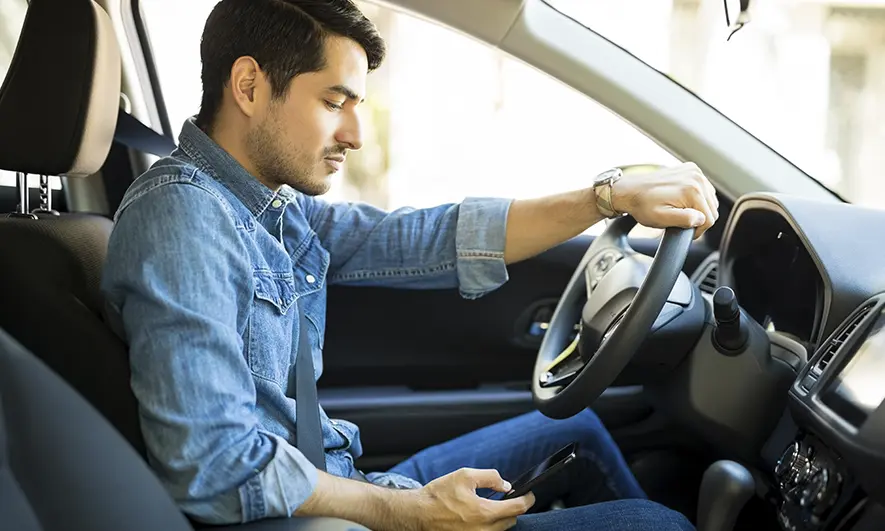
Imagine you’re driving 55 miles per hour on the highway. Would you close your eyes and drive the length of an entire football field? Probably not, but that’s essentially what people do when they glance at their phone to read a text while driving.
Despite the fact that most people believe it’s extremely dangerous to use phones while driving, according to AAA Foundation for Traffic Safety, many drivers admit to doing the following behind the wheel:
- 37% read texts
- 28% send texts or emails
- 11% scroll through social media
Smartphones and other driving distractions can claim lives and cost businesses. How do they affect businesses in particular? Well, nearly every small business has drivers on the road. Business consultants and sales people drive to client meetings. Bakeries deliver wedding cakes. Furniture manufacturers transport orders and construction contractors drive equipment and tools to job sites. In each case, businesses take on risks associated with road accidents—especially when their drivers are distracted.
In 2023, crashes that involved distracted drivers killed an average of nine people per day and injured an average of 890 per day. This added up to 3,275 deaths and nearly 325,000 injuries that year alone. April is Distracted Driving Awareness Month, a time to call attention to this issue in hopes of bringing those numbers down. When business owners also understand the implications of distracted driving for their business and their employees, they’re better able to take actions that improve road safety.
The Business Cost of Distracted Driving
- $16,500 avg. cost of one on-the-job crash
- $74,000 avg. cost when an on-the-job crash causes an injury
- $500,000+ avg. cost when a fatality is involved
Source: https://www.osha.gov/sites/default/files/publications/motor_vehicle_guide.pdf
What Is Distracted Driving?
Distracted driving is any behavior that takes a driver’s attention away from the road or controlling their vehicle. Not only does distracted driving endanger the driver, but it also puts passengers, pedestrians and other drivers on the road at risk.
3 Main Types of Driving Distractions
According to the Center for Disease Control, there are three ways to categorize distracted driving:
1. Visual: Taking Your Eyes off the Road
Examples include reading a text message, checking your reflection or turning to watch something on the side of the road.
2. Manual: Taking Your Hands off the Wheel
Examples include reaching for items in your car, adjusting the music, eating or using a handheld device.
3. Cognitive: Taking Your Mind off the Task of Driving
Examples include talking on the phone, daydreaming, arguing with a passenger or anything else that takes your mind off the task of driving.
Why Business Owners Should Take Action Against Distracted Driving
Nobody wants to get in an accident or see their employees experience one. Plus, there are several ways on-the-job distracted driving affects your bottom line:
- Higher insurance costs
- Medical costs
- Legal expenses
- Fines and penalties
- Property damage
- Workers’ compensation
- Business interruption
- Lost productivity
- Driver disqualification
Common Driving Distractions and How To Avoid Them
Distracted driving comes in many forms, but smartphone use is the most common distraction, according to the National Highway Traffic Safety Association (NHTSA). Texting combines visual, manual and cognitive distractions, making it one of the most dangerous distractions while driving. Dialing a number on your phone is even more dangerous than writing something down while driving.
Many people find that their smartphone easily captures and keeps their attention. When you combine this temptation with how smartphones capture multiple types of our attention, it makes them one of the riskiest forms of distraction while driving.
Tips To Drive Safely and Avoid Distractions
Give the act of driving your full attention at all times. Here’s how:
- Set up before you drive. Before putting your car in drive, adjust your mirrors and your seat, turn on music or other audio entertainment, set the volume and program your driving directions.
- While driving, use your phone’s “do not disturb” feature, silence notifications or put your phone away completely.
- If you have a capable passenger, ask them to do all non-driving tasks. Appoint them as the designated navigator, climate control adjuster and phone user.
- Learn where your steering wheel controls are so you can use them to make adjustments without looking away from the road.
- Pull over when you need to attend to passengers, use your phone, eat, have an important or emotionally charged conversation, read or write, apply makeup or do anything that doesn’t allow you to keep your full attention on the road.
- Avoid conflict with passengers and other drivers.
By following the above best practices, you and your employees can give driving your full attention, protecting lives and your bottom line.